Boys Clothing Size Chart Explained: Sizes, Measurements & Fit Guide
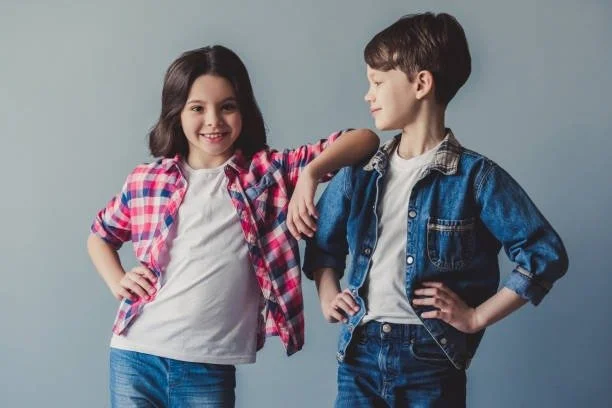
The sizing system for children's clothing has been broken for a long time. Most people just quietly accept it as part of parenting. The trousers were three inches too short because the "right" size turned out to be wrong. Jackets were ordered in size 8 that would fit a ten-year-old.
However, sizing a child for clothes should not be that hard, as we will discuss the perfect measures for kids' clothing. We will provide you with a perfect boys clothing size chart to help you with your perfect dressing.
Why "Size 6" Tells You Almost Nothing
Ask ten clothing brands what measurements they used to define their "age 6" size. You'll get ten different answers if you get an answer at all. That's the core problem.
Age-based labels exist because they're familiar, not because they're accurate. They're built on population averages, statistical midpoints for the median child at a given age. Plenty of children sit near that median.
Another child the same age, smaller in build, might wear age 4 without issue. Same birthday. Completely different sizing. And both are entirely normal.
The age label tells you where the brand placed its median. It says nothing about your child specifically. The practical fix: stop trusting the label and start measuring the child. Four numbers handle the vast majority of fit decisions in children's clothing.
Four Measurements
Height: Height is the starting point. Stand the child against a wall, heels flat on the floor, looking forward. Measure from the floor to the crown of the head. No shoes. This single number drives the proportioning of most children's garments.
Chest: Chest measurement matters for every upper-body garment. Run a soft tape around the fullest part of the chest, passing under both arms, keeping it horizontal. Snug contact with the body, not tight, not loose.
Waist: With your feet shoulder-width apart, measure around the fullest part of your hips to be sure you'll have enough room to move comfortably
Inside leg: The inside leg is the measurement parents skip most often. Stand the child straight, feet together, and measure from the crotch seam point to the floor. Without it, trouser length is a guess, and wrong trouser length is one of those things children notice and complain about immediately.
Keep a running record of these four numbers. Children grow unevenly and fast; re-measuring every two to three months is not excessive during primary school years.
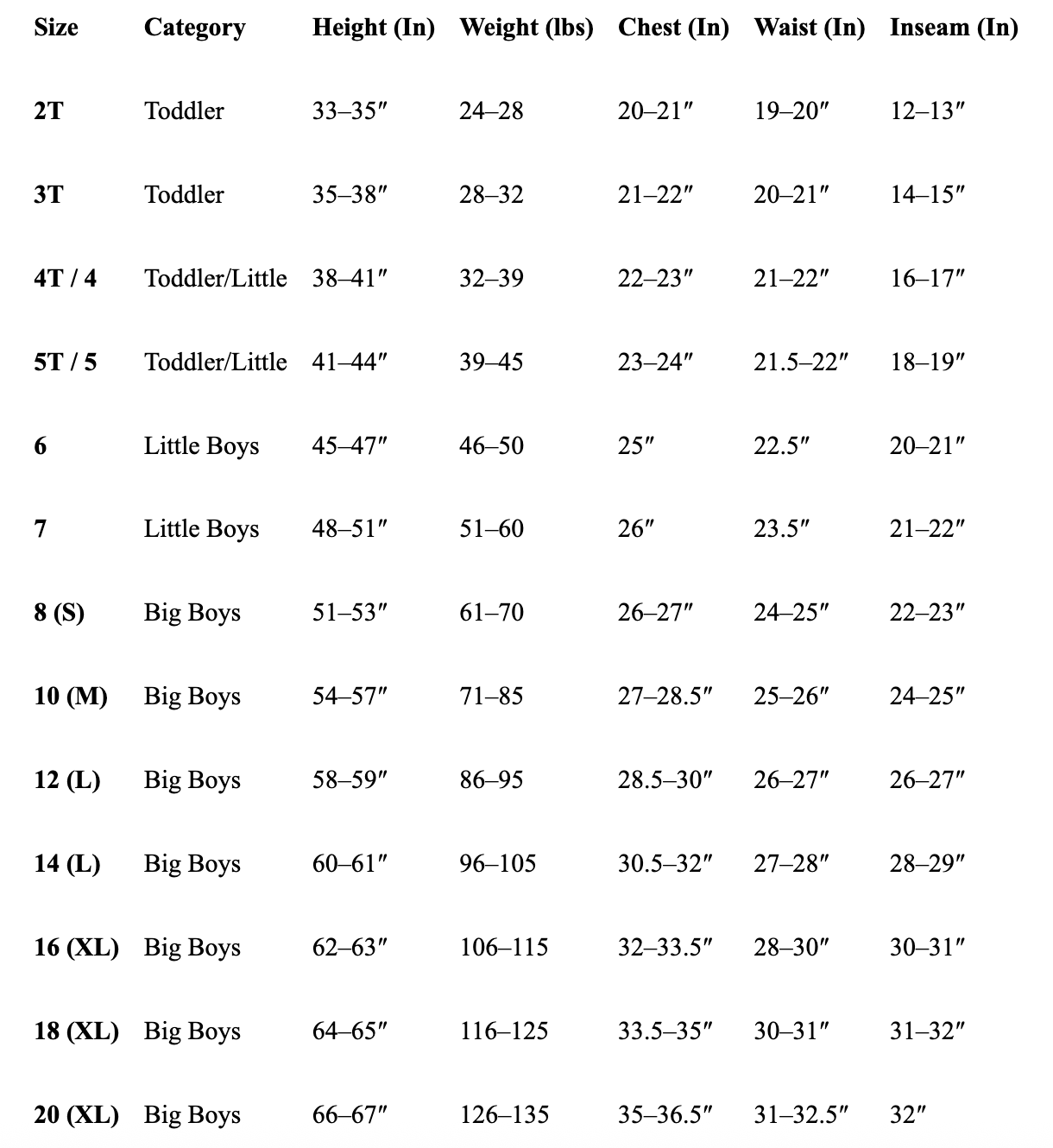
Boys Clothing Size Chart
Outerwear consistently needs sizing up. A jacket bought to chest measurement fits well in September over a T-shirt. Buying coats and jackets one size above the chest measurement is a habit worth developing.
A well-structured boys clothin shows the actual body dimensions behind each size, height range, chest range, waist range, and inside leg rather than restating age brackets. That level of detail is what makes a size chart genuinely useful versus decorative.
The most common is the waist-height mismatch. Between roughly ages five and twelve, boys frequently grow upward faster than outward. The result: trousers that fit the leg length are two sizes too large at the waist.
Adjustable waistbands, the internal elastic-and-button type, genuinely solve this. They're worth actively seeking out rather than treating as a bonus feature.
How to Reduce Returns to Almost Zero
Parents make a reasonable estimate based on the age label. The item arrives. It's wrong. The item goes back. Sometimes the replacement is also wrong. It's a frustrating cycle that burns time and occasionally money when return shipping isn't free.
A few habits that cut through this:
Measure again before each order. Not just at the start of the season, but before each order. A child can move up a full size between September and December. A measurement that was accurate in August may not be in November.
Use the brand's chart specifically. There is no universal children's sizing standard. A UK size 8, a US size 8, and a European 128 correspond to different body measurements, sometimes significantly so. The only chart that matters is the one from the brand you're ordering from.
Note the fabric before deciding on size. Jersey knits have stretch. Structured woven cottons do not. If a measurement puts a child between two sizes, go up in structured fabrics and stay mid-range in knits.
Read recent reviews for fit comments. Other parents are specific about this. "Runs large in the waist," "comes up small in the chest," these observations from people who've already bought the item are often more practically useful than the chart itself for spotting inconsistencies.
How Far Ahead to Buy
Buying slightly ahead of current measurements makes sense. Buying too far ahead is a false economy. One size ahead is the reasonable limit for most garments. The child has room to grow without the item looking obviously oversized from the start.
For daily school wear, bought at the start of the year, one size ahead is fine. The child will grow into it. A smart outfit for a single occasion: buy for the current measurement. Wearing something obviously too big to a wedding or party isn't worth the theoretical saving.
Adjustable features extend this calculation. Trousers with a genuine adjustment range, the kind where you can take in two full inches at the waist, give you that extra longevity without the fit penalty. Worth paying slightly more for when buying for fast growers.
Choosing Where to Buy: What Actually Matters
The quality of a brand's size chart is a reliable proxy for how seriously they take fit overall. A chart showing height, chest, waist, and inside leg for every size says, "We measured real children and built our sizing around those measurements." A chart showing age ranges and one body measurement says, "We did the minimum."
Specialists tend to do this better than general retailers. When children's clothing is the entire product focus, not one department among twenty, the sizing and construction decisions tend to reflect more considered thinking.
Siukid focuses specifically on children's clothing, which tends to mean more detailed sizing documentation, more consistent size grading across garment types, and ranges built around how children actually grow rather than scaled down from adult patterns.
Conclusion
The children's clothing sizing problem is real, but it's also solvable. The shift that fixes most of it is moving from age labels to actual body measurements. Height, chest, waist, and inside leg numbers that tell you more than any age bracket ever will.
Combine those measurements with a brand-specific size chart that shows real body dimensions, an understanding of how a boys clothing size chart behaves across different growth phases, and a sensible approach to growth room, and the guesswork mostly disappears.
Children still grow unpredictably. Some things will still need returning. But "most things fit" is a significant improvement over "returns are just part of buying kids' clothes," and it's genuinely achievable with a bit of structured thinking.
FAQs
My child is between two sizes on the chart. Which one should I choose?
It depends on the garment type and fabric. For structured fabrics, cotton twill trousers and woven shirts go up. These don't give, and a slightly large fit is better than a garment that won't fasten. For jersey tops, sweatshirts, and knitwear, stay at the smaller size.
How often should I re-measure my child?
Every two to three months during primary school years is a sensible routine. Some stretches see almost no change; others see a child jump a full size in six weeks.


Latin American fashion is not only beautiful; behind it lies a group of creatives who are transcending the industry through empathy, ancestral knowledge and artisanry. So, in honor of National Hispanic and Latino Heritage Month, I have put together a list of sustainable brands that are making a difference through their work.