
One good suit, worn often: rethinking tailoring for a slower wardrobe

Ask most men when they last wore a suit and the answer tends to arrive with a date attached: a cousin's wedding, a job interview, a funeral nobody wanted to dress for. Afterward the suit goes back into its plastic bag and waits, sometimes for years, until the next occasion comes around and it no longer fits the body or the mood.
For anyone trying to buy less and keep clothes longer, that cycle is worth questioning. A suit is one of the few garments designed from the start to be pressed, repaired and altered, which makes it strange that so many of them end up worn a handful of times. The most sustainable suit is probably the one you actually reach for, so the real work happens long before the checkout page, in how you choose it, how it fits and how you look after it.
A suit is really two separates
Part of the problem is how we've been taught to think about tailoring. A suit gets treated like a costume for formal days, when a plain navy or grey jacket can just as easily go over a knit polo on a Friday, and the trousers can show up on their own with a sweater and clean sneakers. Once you start seeing the jacket and trousers as pieces that work apart, the cost per wear changes completely, and so does the likelihood that either half gathers dust.
Mens suits that let you size the jacket and trousers separately make this easier, since very few bodies match the standard gap between the two. Suitsupply is one brand built around that idea: its Mix & Match range lets you pick each half in its own size, many of its all-season suits are cut from a tropical wool made by the Italian mill Vitale Barberis Canonico, and its stores have tailors on site for alterations. A lighter all-season cloth matters more than it sounds, because a suit you can wear from spring through autumn gets far more use than one that only makes sense in January.
Colour follows the same logic. Navy, mid-grey and charcoal pair with almost everything already in a wardrobe, while a bold check or a statement shade tends to be remembered after one outing. There's nothing wrong with a louder second suit, of course, but the first one should be the quiet workhorse.
Fit decides whether you'll wear it
Before thinking about cloth or colour, check the fit, because a jacket that pulls at the shoulders will end up at the back of the wardrobe however good the fabric is. Some problems are simple for a tailor to fix and some are close to impossible, and knowing which is which in the fitting room saves money and a second trip.
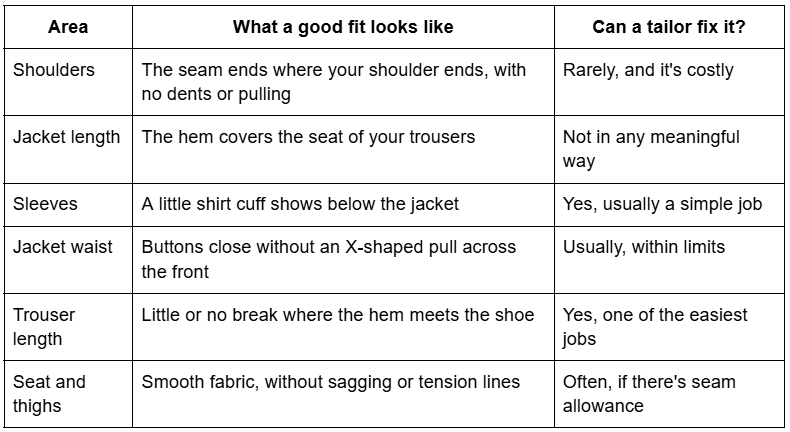
The practical rule is to buy for the shoulders and the jacket length, then let a tailor handle everything else. A suit that has been adjusted to your body feels different to wear, and people tend to keep reaching for clothes that feel like theirs.
What the waste numbers say
Why does any of this matter beyond looking sharp on a Monday? The clothing industry throws away an enormous amount. The Ellen MacArthur Foundation, which has spent years researching circular fashion, estimates that the equivalent of a garbage truck of textiles is burned or sent to landfill every second. Its 2017 report on the textile economy also found that global clothing sales more than doubled between 2000 and 2015, while the number of times each garment was worn went down.
Against that picture, a well-made suit that gets worn for a decade is a small but real act of resistance. It lines up with the seasonless, slow-produced approach that designer Juan Luis Valadez described in his interview with Jejune, where the value of a garment comes from how long it stays in someone's life.
It's worth being honest about materials, too. Most traditional suiting is wool, which won't suit readers who avoid animal fibres. For them, a secondhand or vintage suit, taken to a tailor and fitted properly, may be the most consistent choice, since it keeps an existing garment in use without creating demand for new fibre.
Keeping one suit in shape for years
Care is where most suits are won or lost. Give the jacket a day's rest between wears so the cloth can recover, and hang it on a wide wooden hanger that supports the shoulders instead of a thin wire one that slowly deforms them. A quick pass with a clothes brush after each wear lifts dust before it settles into the weave, and a steamer will release creases far more gently than an iron pressed straight onto the fabric.
Dry cleaning is best saved for when the suit actually needs it, such as a stain or a lingering smell, because the chemicals and heavy pressing take a toll on the cloth over time. Trousers usually wear out before the jacket does, so rotating them with other trousers during the week, or buying a second pair when the suit is new, can add years to the set.
So the next time a wedding invitation arrives, ask whether the suit you buy for it could also go to dinner on a Tuesday, to the office with a knit, and to the three weddings after that. If the answer is yes, it has earned its place in the wardrobe.

Latin American fashion is not only beautiful; behind it lies a group of creatives who are transcending the industry through empathy, ancestral knowledge and artisanry. So, in honor of National Hispanic and Latino Heritage Month, I have put together a list of sustainable brands that are making a difference through their work.