Rob Strati On Turning Accidents Into Artwork

Rob Strati understands the important relationship between artwork and politics, and spoke to us in this interview about his intricate creative process when he designs his projects. His most popular collections feature ceramics and plates that have been broken and reorganized into a completely new image, showing the importance of giving up a little bit of control with your art to allow the unexpectedly beautiful to happen.
Where are you from?
I was born in Boston and grew up in Columbus, Ohio. We drove back to Boston and Cape Cod every year to spend time with my extended family there, so that sense of being connected to different places and cultures and people with unique accents was definitely part of how I grew up. I live in New York now, but Ohio is still a place I return to often, both personally and professionally.
How has your hometown influenced yourself and your creative instincts?
I think growing up in the Midwest gave me a certain relationship to everyday objects and things that we would find as teenagers around abandoned buildings and barns, there was an adventure to that. Also, there was a sense of freedom to create art and a lack of pressure growing up in the Midwest in the ‘80s and ‘90s, but there was also an emerging exposure to Contemporary art.
I think it drew me to being interested in things that may not initially seem important or valuable, but have histories attached to them. A plate that might be worth $15 online could have sat in someone’s family China cabinet for seventy years and carry enormous emotional value. That difference between monetary value and personal or historical value has become a big part of my work.
What inspired you to become an artist?
I have always made art since being a small child and it has always just been part of who I am. My parents were supportive in different way, my mom is very creative in the way she thinks and would always start new creative projects of her own. My dad always admired the artistic lifestyle and the idea of artists spending summers in cottages on Cape Cod writing or painting and living a creative life.
I think importantly, teachers and friends recognized my abilities and interests and were encouraging too. Also, I remember being a teenager and looking at magazines like Paper, Art News and Vogue and seeing these artists in the ‘80s being celebrated and becoming successful and I saw there was a way to do all of that.
We are obsessed with your Fragmented collection. Can you tell us what inspired this collection?
It started completely by accident in the fall of 2020. My wife, Jocelyn, dropped a Blue Willow plate in our kitchen that had belonged to her late mother, Barbara. I kept one of the larger pieces on the kitchen island for about three months. I would move it around as we cooked or cleaned, but I couldn’t throw it away.
One day I looked at the fragment and what had always been a blue and white geometric pattern all of a sudden revealed itself to me to contain a small monk crossing a bridge and a bird and I have a visions of a world beyond the broken edge.
It took a few more months after that, but I had moved the fragment to my studio and had some paper cut for a drawing, but it was actually on Jan. 6, 2021, when the insurrection at the Capital in Washington D.C. was happening that I got up and made the first one. It wasn’t so much in reaction to what was happening, but more I just found myself at the table starting to draw.
So, we know the first plate was accidentally broken. How do you get your plates and how do you break the rest?
I find them at secondhand stores, estate sales, eBay, Etsy, Replacements.com and other online sources. I’m usually looking for plates that have an image or visual language that I feel connected too and inspired by. Many of them are cracked or stained and sometimes people send me plates they have accidentally broken too.
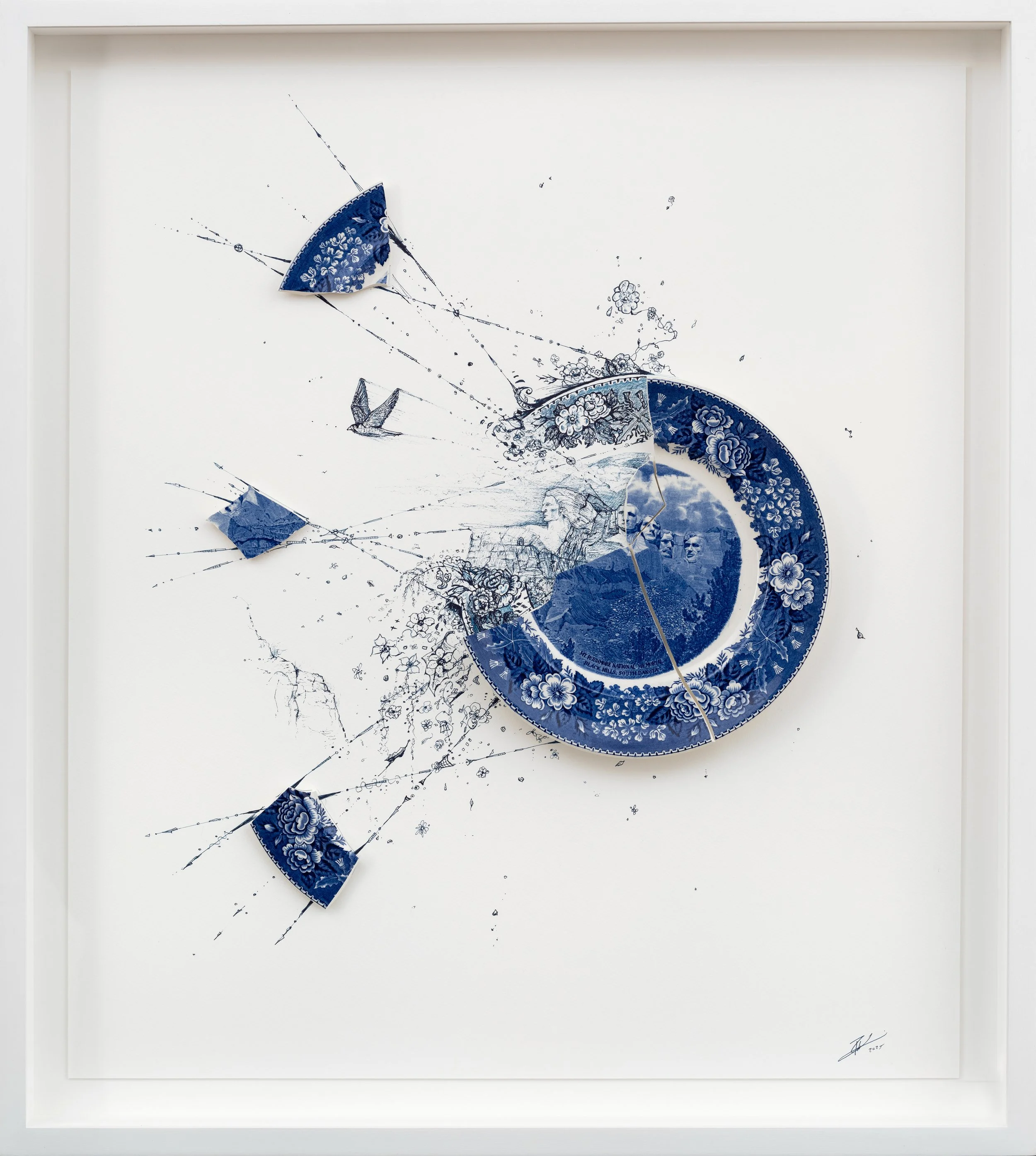
After the first accidental break, I began breaking the plates intentionally and have tried a few ways. I started breaking them on our driveway, then I found using a large rock in a cardboard box gave me a bit more control, and now sometimes I use tile clippers. All of that has evolved over the past four years, but I can never fully control the result.
I like that aspect of chaos in the work and being creative with the unknown. It is a balance of chaos and control. The drawing is very controlled for the most part, but there are even accidents and things that happen in there that are unexpected.
What comes next? Are you inspired and know what you want to draw before breaking the plate or does it come to you after seeing it shattered?
It is definitely a mix, I have an idea for a scene based on what I have learned about plates and the patterns of transferware, but once I start working on each piece something new starts to take shape.
I’ve been working on a commission that features a battle scene and boats coming from a Royal Doulton place “Battle of the Nile.” I had been working on it for a few months when one day I had a vision that a few cannonballs flying across the scene would be interesting. It was a surprising and unexpected idea because I hadn’t used cannonballs in my work before, but again, everything seems to evolve working with these objects.
Who or what are some of your biggest inspirations for your work? What does this collection mean to you?
I would say from a modern and contemporary perspective artists like John Cage and his interest in chaos, Duchamp’s “Large Glass” and his acceptance of the shattered glass in that piece. Basquiat's use of expressive lines and a mix of intellect, symbol and graffiti scrawls as well as Twombly with a similar use of expressive lines and scratches into the paint.
All of that merges with the original artists who came up with the patterns for the plates. There is definitely an intimate relationship there because I am replicating what they created to a certain extent and the really requires a kind of mind melding which I had never experienced before, but have found to be so interesting.
I was just part of a talk at the Metropolitan Museum of Art with Vicki Parry, the ceramics conservator, where we discussed these ideas of replication. It was so exciting to share ideas with her on what that all means when you are working with pieces that were originally created by someone else.
We really like your Service collection, which focuses on political and historical plates. How did this idea come about? What made you want to create this collection? How is it different from your Fragmented collection?
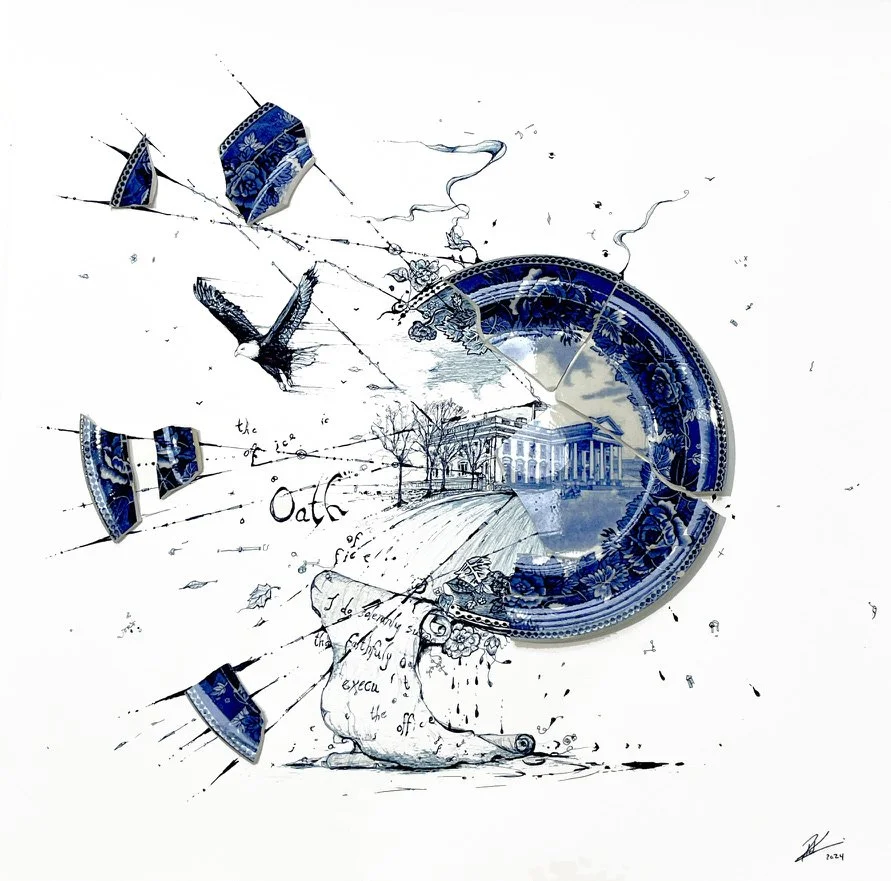
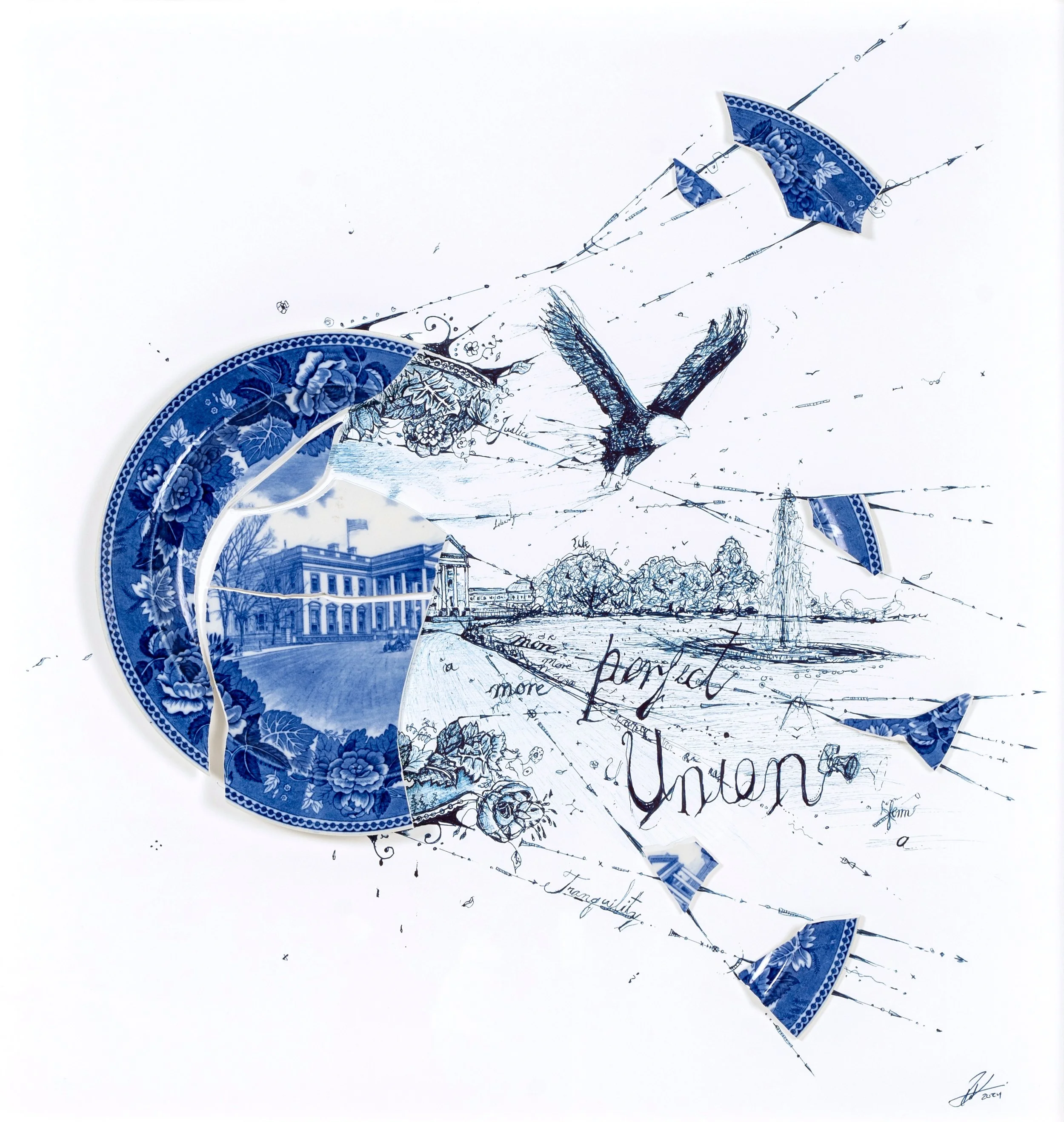
Service grew out of a need to make some kind of statement about the political environment we find ourselves in in the U.S. over the past decade. I was feeling sort of powerless, and this was a way I could make some kind of statement on how things are broken and we need to use deep creativity to start building something new. This is really part of the overall series too, but I began finding plates depicting George Washington, The White House, the United States Capitol, presidents, monuments and other images connected to American history and it gave all of that a new focus and clarity for me.
One of the key differences is Service also questions how we assign value and how people connect with each other in the acquisition process. Instead of pricing the works only according to size, I began tying the prices to historical years. A work relating to the peaceful transfer of presidential power, for example, references the year 1797, when George Washington voluntarily left office after two terms.
So, the value of the work becomes related to something other than traditional means of valuation (scarcity, size, provenance etc.) and ties more directly to a kind of connection around shared values or ways of seeing. It has been so exciting to see how people have really understood this and have wanted to participate in this kind of acquisition.
What do you hope your audience gets from looking at these two collections?
Before I started doing this work full time, I was in research and did qualitative interviews with people to understand how they felt about different products. I sort of carried that over and have learned a lot about what people are taking from the work. I just love their reactions.
Because so many people grew up around these plates, they already have a connection to them and bring their own history to consider what they are experiencing. The ideas of something breaking free from it confines and becoming something new, the power in making something beautiful out of something broken, the integration of the past and the present and this kind of experience related to loss and how through sadness, fear, acceptance something new emerges related to the past, but of its own are all things I see people taking from the work and I really appreciate it too.
How would you describe the relationship between art and politics?
I think art and politics are tied together because they are both making a statement about existence and taking a stand. With Service, I’m using objects that already carry political and historical meaning. Breaking a plate with The Capitol or George Washington on it changes the image before I have even drawn anything. The question for me becomes what happens next and what is the new thing that will emerge from what has occurred?
So often, we are not called on to make a statement, and probably actually encouraged to diminish ourselves and go along with what is happening. When an artist makes something, we are creating a position, which I think is at the core of what politics is supposed to be.
What advice do you have for artists just starting out in their careers and are trying to find their voice?
Follow what inspires you, pay attention to visions that come to you, enjoy your life, use your art to build realities you desire and never quit … you can always take breaks (hours, days, years), but never quit.
It has been a crazy last few years, and we expect at least three more. How do you stay positive in general about the unknown and motivated as an artist?
I have been focusing more and more on my work and sharing it. That process has been what has connected me to more and more people who want to move away toward something new and creative and rooted in being a human being.
I see what is happening around us as detached from reality and being constructed by a small group of people who can’t see how lost they really are because they are enmeshed in a system of self-referencing mechanics, they are trapped.
Most of the world is outside of those mechanics and that is where I choose to focus more and more – get into nature, exercise, spend time with people you love, and create.
What can we expect next from you short term in your career?
There is quite a lot happening. I was just part of a talk at The Metropolitan Museum of Art, which was a dream come true. Also, I’m continuing to develop both Fragmented and Service, and I’m working on a book about the work with an essay by Glenn Adamson.
I currently have work up at the Studio Shop Gallery in Burlingame, CA and in London at Miart Gallery, I also have an upcoming exhibition with Cavalier Ebanks Gallery in Greenwich, CT in November, my work can be found at Art Miami with Fremin Gallery in December, and a unique project in Palm Beach with Adelson Gallery.
I’m also interested in pushing the work beyond the wall pieces and thinking more broadly about objects, ceramics, history and how these ideas might exist in different forms.
What is your motto in life?
I don’t know that I have a formal motto, but the song I sing at karaoke is “That’s Life” by Frank Sinatra, although I would change the last line to something a bit more positive.
To learn more about Rob Strati, please check out the links below:
Instagram: @robstrati
Website: porcelainprojects.com


Clara Woods is an artist, motivational speaker, influencer, and host of The Inclusion Matters Podcast. Despite suffering from a prenatal stroke that left her unable to read, write, or speak, she has been able to use her passion for art and large social media presence to educate, inspire, and uplift. To learn more about Clara Woods and her art, read on.