Clara Woods: Inspiring Inclusion
Clara Woods is an artist, motivational speaker, influencer, and host of The Inclusion Matters Podcast. Despite suffering from a prenatal stroke that left her unable to read, write, or speak, she has been able to use her passion for art and social media platform to educate, inspire, and uplift. To learn more about Clara Woods and her art, read on.
Where are you based?
We are based in Costa Mesa, California, South of Los Angeles.
At the age of 10 your mother, Betina, decided that you should be an influencer. What made her decide to go this path, and how has this changed your life?
Betina: I was super afraid of Clara’s future. The more she grows, the more I see how the world is not welcoming people with disabilities and giving them opportunities. Clara was always happy, always bringing the light to each room she entered so I thought we could expand it, but I never imagined that this decision would changed all our lives. Now Clara and I are building a future together, creating our own opportunities and the message she gives is touching so many hearts around the world. This is the power of her art and her voice even without speaking.
Clara: Changed my life because now I can work, I have hope for the future. I can travel, I’m making friends, I’m having experiences that I would never before. I don’t know how my life would be without art and my community!
What inspired you to start creating art?
Clara: I started just to make an activity, and I used to destroy my art because I didn’t like it. Then I was using more forms, colors and people like it. But Frida Kahlo was the one that really inspired me. My mom gave me the book of Frida Kahlo and I fell in love with her, her history and her art. So I showed my mom the page of the book of Frida Kahlo in New York and asked my mom to have my exhibition in New York as Frida did. My mom said yes, and we started just like that.
Where does the inspiration for your pieces come from? Are there any artists in particular that inspire you?
Clara: My inspiration comes from everything that happens in my life, people around me, TV shows I watch, trips that I do. Also my emotions play a big part of it! As I said, Frida Kahlo. I’m also inspired by Basquiat, Van Gogh, Gianpiero, David Pher, Sophie Tea, Timothy Goodman, and Abby Wren.
What does your creative process look like?
Clara: Sometimes I have a project and I sketch it before, but most of the time I keep it in my mind and I just do it. It is challenging because people around me in the studio expect more clarity in the projects, but it is difficult for me to share, also because of the limits of my communication. Sometimes I get tired, and it is too much. For me the studio is the place I can be 100% myself, so I want full freedom to do whatever I like. I feel a lot of pressure when I have commission artworks to do because I’m always afraid if the person will like it or not because my style is unique and I use strong color combinations!
If you had to choose, what would you say is your favorite piece you’ve made? Do you ever just keep a piece for yourself?
Clara: Mostly, when the artwork is done, it is done for me. But I have some pieces that I love and sometimes I ask mom to not sell straight away. I kept the first portrait I made of Frida Kahlo that I exhibited in my first exhibition in 2018 in Florence, Italy.
You have such cool clothing! Your wearable art is amazing! Will you be putting more fashion on your site?
Clara: Yes, my mom works non-stop and she has good ideas. People loves the clothing I paint with it, and they buy it or to use or to frame and hang on their wall!
Betina: Yes, we are working on it, and it is so nice that now people that uses Clara’s Clothing Collection can find other people from the community because they are recognizable from the art.
As a baby you suffered a stroke which has left you nonverbal, unable to read and write, and left you mobility restricted. Can you tell us a little bit about how you use your art to communicate with the world around you?
Clara: My art is where I have 100% freedom to create, but most of all it became a way to connect with people, to have a shared thing that does not need to use words or to explain. This weekend we were at the house of a collector and it was so cool to meet him, his family, to see how the art changed this life, and his house.
Even though you are nonverbal you seem to have your own language with your family. Can you tell us a little bit about this and how it works?
Clara: We have signs and we can understand each other super well, takes a bit more time. But know I’m trying to dedicate myself to learn more vocabulary with my photographic memory so I can communicate easily with everyone else. I can use the phone to read, and also to send text messages because the suggestions the phone gives me helps me a lot.
Betina: One of the biggest damages Clara has in the brain is in the output of the information, because of that, she can’t write, read or speak. It is also difficult to use sign language, because it is always using the output of the system. We tried Italian Sign Language, and American Sing Language, but it was hard for Clara to be able to use it. On the other hand the input of the information is perfect and because of that she can understand English, Portuguese and Italian. If we spell the letters of the alphabet for her, she can write. Poor baby, because I make a mess spelling all mix between all the three languages, and she keep up!
As the founder of The Inclusion Matters Movement and host of The Inclusion Matters Podcast you’ve been able to create a large platform for yourself. What are some ways in which you are able to use your platform to uplift and inspire others? What do you hope to educate others on?
Clara: I love that people get inspired by me and what I do. We have a WhatsApp group that my mom send a lot of messages of people sharing how they feel when they see my videos, when they open my art and this is so nice. People who started going to rehab and physiotherapy, people who started painting again, people who got out of depression.
Betina: In the beginning, we were doing to create an opportunity for Clara, now it became a mission, because we get so many messages everyday about how our message changed people lives. I think the more we talk about, the more we share, the more we can educate, more people can understand the challenges of having a disability and the power of being included. But first we need to break the fear that is out there and the only way is sharing, is giving people opportunity to ask and to understand.
How do you choose what topics you want to cover and who to interview?
Betina: We choose the guest based on our values, people we love, and things we want to share. We make a research and share with Clara through Instagram profiles, videos about the person and talking about it. Then Clara shares if she has some specific questions, otherwise we created the questions and share with Clara for her approval. In the first season Clara felt a bit disconnected because for her the AAC tablet is too slow and it was difficult to her to manage it and express herself with more freedom. Probably the second season we will do together so she can communicate more like everyday for her!
You use an AAC Tablet when interviewing people on the podcast. For those not in the know, how does an AAC Tablet work? Do you need to be able to read to use it?
Betina: AAC is a software that has images combined with words and when you click it reads for you. It can be super customizable for each person needs. You don’t need to be able to read to use it because you can identify the images.
You are getting into motivational speaking, congrats! As a nonverbal person can you tell us a little bit about how you will approach that?
Clara: This is my mom, always pushing me through. I’m trying to get better at using my vocabulary and the suggestion on the phone, and I’m using a new app called Spoken, which is faster than the AAC software and it is integrated with AI. In the first moment, I’ll be doing it with my mom, we will be a duo, since we communicate super well and my mom can understand me even without looking at me. But my goal is to start doing by myself.
You’ve been featured in major publications, including Forbes, Good Morning America, and Los Angeles Times, and have been featured in two documentaries and two children's books. What has been the most rewarding experience in your career so far?
Clara: When I meet people and interact with them. When I feel included. I made so many friends that would not be possible without my art and my career. But right now I’m so excited to go to Italy and see my artwork for the Olympic Games.
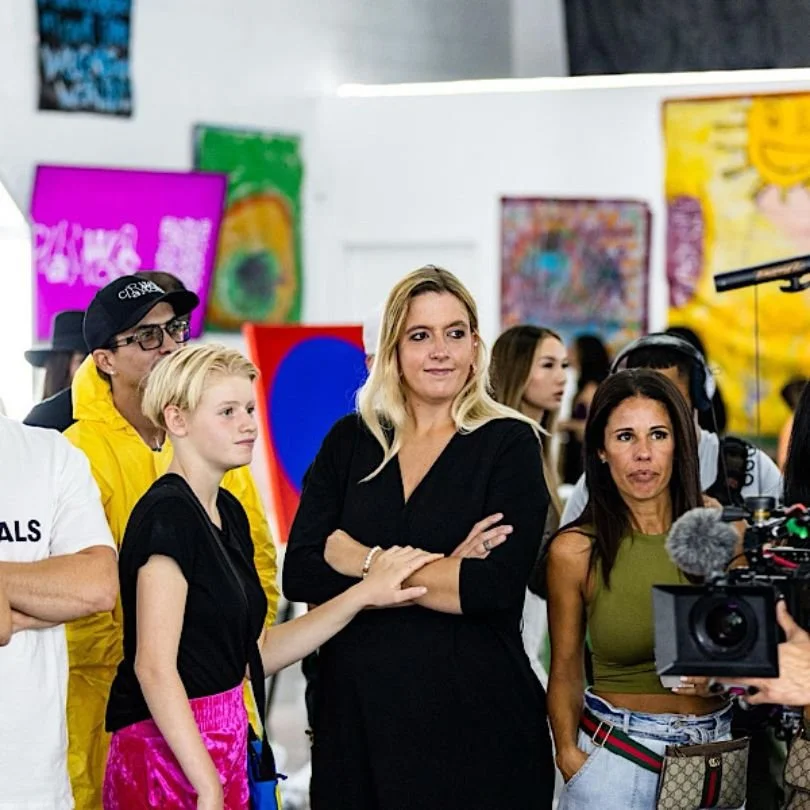
Clara and Betina
What advice do you have for other young individuals with disabilities who want to pursue a creative career?
Clara: Keep going, keep creating, and find someone to help you! It is so difficult to do it alone. Don’t feel ashamed by your limitations because you have lots of resources that others do not have!
Are there any upcoming projects you are currently working on that we should be on the lookout for?
Clara: Yes, we are bringing the Unmuted Tour to Italy, New York, and Calgary in Canada. The tour is a pop-up art show and the theme is about it: "Sometimes people think that because I can't speak, I don't have a voice. But I do — and I also use colors instead of words. That's how I paint: with my hands, my energy, with hope and love. And even if my voice sounds different, I want you to hear me." — Clara
It has been a crazy few years, and we expect at least three more. How have you been staying positive?
Clara: Painting, and focusing on the good things in life! Even the small ones!
What is your motto in life?
Clara: Keep going! Never Give up! Dream Big! You can find beauty in life!
To learn more about Clara Woods, please check out the links below:
Clara Woods Collection
Instagram: @woods_clara_
YouTube: @clarawoods
Cj Hendry is known for her extremely creative hyper realism whimsical art. She has a long history of bringing childlike experiences to New York City, from a giant bouncy castle room to tons of beautiful artificial flowers and now her new creation, Pastel.