MARALOVE: Intuitive Art
Mexican-American artist Mariel Méndez (MARALOVE) views art as a way to understand the world around her. She utilizes painting, photography, and styling as her means of expression. For her, inspiration can be found within emotion and intuition. Passionate about ocean conservation, she’s worked with organizations like Azul and Kilómetro Uno. To learn more about MARALOVE and her art, read on.
Where are you based?
I am based in San Diego, California, with a deep connection to Tijuana, Mexico. Both places live within me—they shape my sensitivity, my visual language, and the way I understand identity and emotion.
What’s the story behind where your love for art came from? What inspired you to start MARALOVE?
My love for art didn’t begin as a decision—it was always a way of understanding the world. Before becoming a full-time artist, I worked as a Montessori guide, where I learned how deeply creativity lives within us when we allow it. MARALOVE was born from a need to express what I couldn’t always say in words. It started as painting, but quickly became something more—a space where art, emotion, and life could exist together.
A lot of your work explores emotion and human connection. Why do you feel connected to these themes? Where do you find inspiration when creating a collection?
Emotion is something we all share, yet we rarely sit with it fully. I feel drawn to that space— what is felt but not always spoken. My inspiration comes from everyday life: quiet moments, relationships, memories, the way light enters a room. I don’t force concepts. I let them reveal themselves slowly, until they feel honest enough to become a collection.
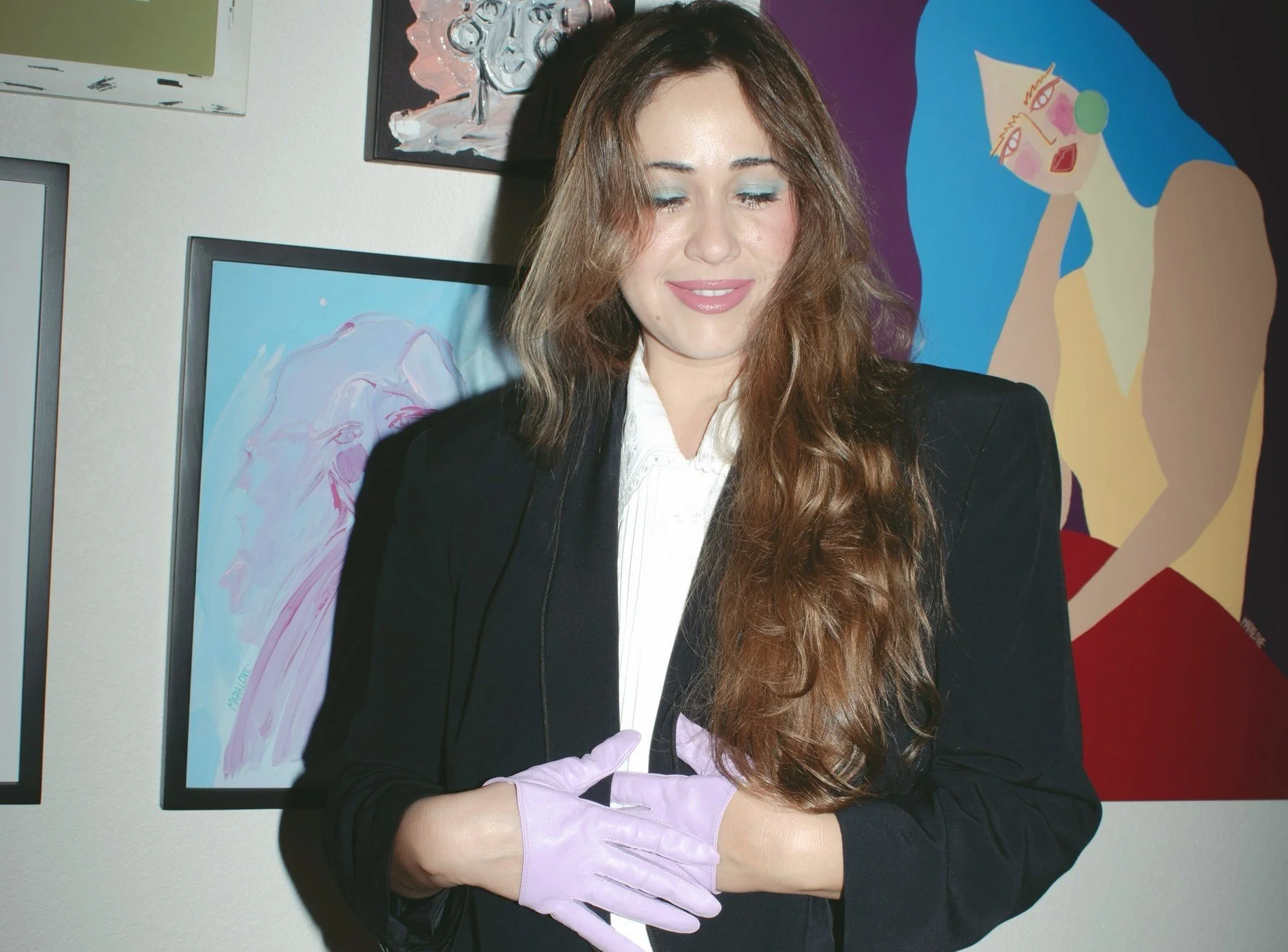
Creative Direction: MARALOVE
Model: Ileana Méndez
Photo Credits: Jackie Gallardo
What does your creative process look like?
My process is intuitive. It often begins with a feeling rather than a clear idea. I sit with it, sketch, write, observe… and slowly it takes form. Sometimes it moves through painting, other times through photography, styling, or objects. I allow the work to choose its medium.
You create art not just through painting, but also through photography and styling. How does the intersection of these art forms allow you to communicate your artistic messages more clearly?
For me, painting is just one language. Photography and styling allow me to extend the narrative into the real world. They bring the work into spaces, into the body, into movement. It becomes something you can not only see—but feel, wear, and inhabit.
You use a lot of second hand styling for your photography. What inspired you to focus on this more sustainable approach?
I’ve always been drawn to pieces with history. I feel something different when I find a garment that has already lived a life—it carries memory, texture, and a kind of quiet soul. For me, it’s not only about sustainability, it’s about connection. I like giving new life to something that already holds a story. It feels very aligned with the way I create—nothing starts from zero, everything comes from somewhere.
Advocacy and sustainability naturally aligns with your approach to art. How do you think art as a form of advocacy differs in the way it connects with and inspires people as opposed to more traditional forms of advocacy?
I feel that art doesn’t impose—it invites. When I create, I’m not trying to tell people what to think. I’m opening a space where they can feel, reflect, and connect in their own way. That emotional connection can stay with you longer than information alone.
You’ve collaborated with Azul, an organization working with Latinos to conserve marine resources. Can you tell us more about this organization and how they work towards achieving their goals? How have you helped contribute to this organization?
Working with Azul felt like an extension of my practice into something larger than myself. It allowed me to connect my work with the protection of our oceans and the communities around them. Through what I create, I try to bring awareness in a way that feels human and accessible — creating an emotional entry point, rather than just a message.
You’ve also collaborated with Kilómetro Uno, another organization supporting ocean conservation. Why is this cause important to you?
The ocean has always felt very present in my life. It holds a quiet power—it gives, it sustains, it reflects. Growing up close to it, I developed a deep respect for it. Protecting it doesn’t feel separate from us—it feels like protecting something that is part of who we are.
Collaboration with the nonprofit organization Azul and Kilometro Uno.
In May, you’ll be a part of a fundraising event supporting A Su Futuro, an organization dedicated to empowering students to continue their education from middle school through university. Why did you decide to get involved with this event? How will you be participating?
Being part of something that supports young students in continuing their education felt deeply meaningful to me. It aligns with what I believe — that creativity and opportunity should be accessible, not limited.
What advice do you have for young girls wanting to pursue a creative career?
Trust your voice, even when it feels uncertain. You don’t have to fit into anything predefined. Your sensitivity, your perspective, your way of seeing — that’s not something to hide, it’s your strength.
Are there any upcoming projects you are currently working on that we should be on the lookout for?
Right now, I’m exploring new ways of extending MARALOVE beyond the canvas—through fashion, objects, and more immersive forms of storytelling. There are also upcoming exhibitions and collaborations that continue to blur the line between art and lived experience.
Creative Direction: MARALOVE
Model: Ileana Méndez
Photo Credits: Chris Aragon
It has been a crazy few years, and we expect at least three more. How have you been staying positive?
I’ve learned that creating doesn’t always look the same. There are moments when it slows down, or shifts into something different. Instead of resisting that, I’ve been allowing myself to move with it. That acceptance has brought me a sense of grounding.
What is your motto in life?
For me, art is not something to observe—it’s something to inhabit. It’s present in the way I move through life, in the spaces I create, and in the objects I choose to surround myself with. I don’t see art as separate from who I am, but as something that lives with me, quietly shaping how I feel, see, and exist.
To learn more about MARALOVE, please check out the links below:
Website: www.maraloveshop.com
Instagram: @mara.love
Contact: maralovestore@gmail.com
G’Ra Asim finds creative outlets for self-expression in everything he does. Teaching, writing, reading, making music and more are all pursuits he has delved into as a means of connecting with others through their share in their beliefs and passions. He has worked closely with multiple bands, sets of students and political organizations like the New York Immigrant Coalition, Say Her Name, and the African American Policy Forum to stand up for and support the rights of all people of color across the country.